Financing is where manufactured homes diverge most sharply from a conventional house purchase, and where a little understanding early saves real money later. But before getting to loan types, it is worth reframing what is actually being financed.
Start with the total project, not the sticker price
Buyers often compare a manufactured-home price to a site-built listing price and conclude the math is obvious. It usually is favorable — but the two numbers are not measuring the same thing. A listing price includes the land, the foundation, the utilities, and the driveway. A home price does not.
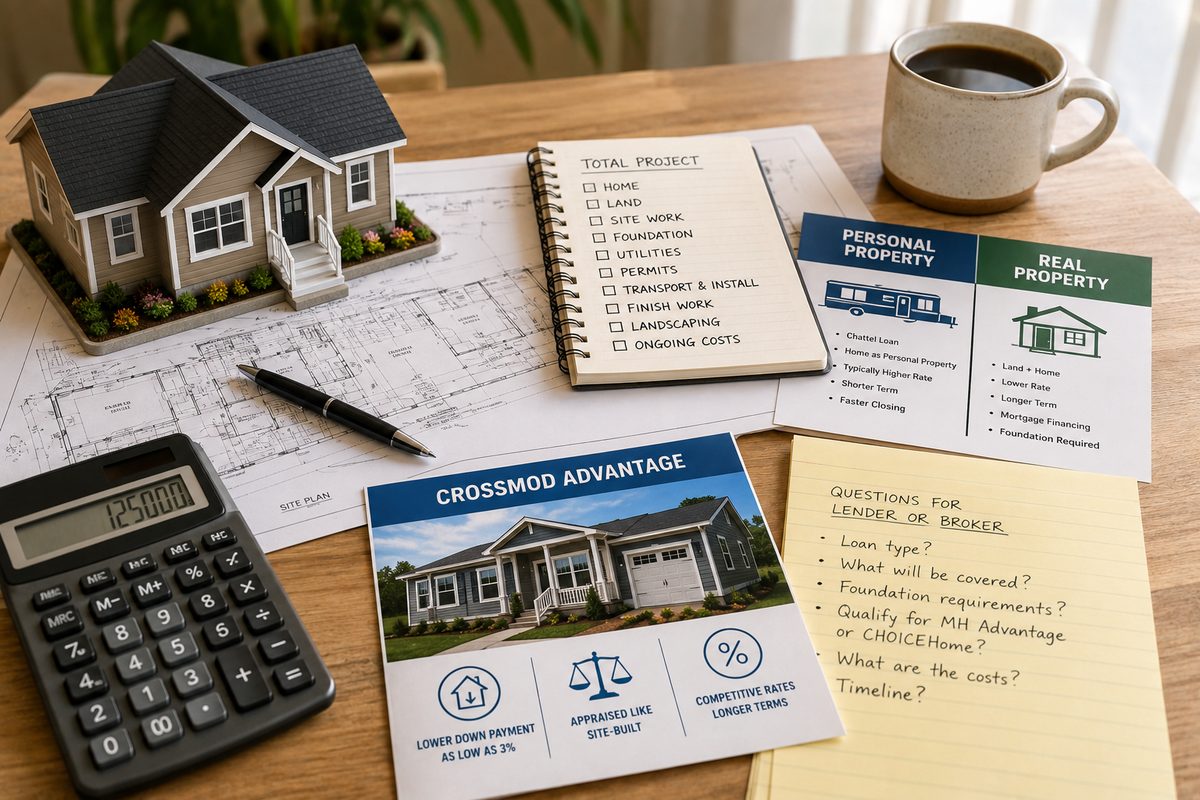
Depending on your situation, the full project may include some or all of the following:
- The home, including options and upgrades
- Land purchase, or rent for a space in a community
- Site preparation: clearing, grading, and drainage
- The foundation or support system
- Utility connections — water, sewer or septic, electrical, and gas or propane
- Access work such as a driveway or turnaround adequate for delivery
- Permits and agency fees
- Transport and professional installation
- Skirting, stairs, landings or ramps, and decks
- Landscaping, and in wildfire-prone areas, defensible-space work
- Ongoing costs: property taxes, insurance, and any community rent
Not every project carries every line. A home going onto an improved space in a community skips most of the site work; a home going onto raw land may carry all of it. What matters is that you and your lender are looking at the same total, because a loan sized to the home alone can leave a gap you have to close in cash.
The fork in the road: personal property or real property
Nearly every financing question traces back to this one distinction.
Chattel loans (the home as personal property)
A chattel loan finances the home itself as personal property, separate from the land. This is the common structure when the home will sit in a community or on leased land, and it is sometimes chosen simply for a faster, simpler closing. Chattel loans typically fund more quickly and carry lower closing costs than a mortgage, but they generally come with higher interest rates and shorter terms.
Real-property loans (land and home together)
When the home is placed on a foundation system on land you own, it can often be financed — and titled — as real property, much like a site-built house. That generally means access to lower rates and longer terms, and the home is positioned to be appraised against conventional comparables. The trade-off is a more involved process: appraisal, title work, and a foundation that meets the requirement.
In California there is a specific step that makes this real. Form HCD 433A, the notice of installation on a foundation system, is recorded under Health and Safety Code section 18551 once the home is installed on an approved foundation. Recording it converts the home from personal property into a fixture or improvement on the real property. From that point the home is subject to local property tax and is no longer registered with HCD as a vehicle-style title. For a used home, outstanding titles must be surrendered and any liens paid off or consented to before the recording can proceed.
Lenders and title companies generally want this step completed for a real-property loan, and it is usually coordinated as part of the installation and permit process rather than handled separately afterward.
A third path: a long-term ground lease
There is a structure in between the two that many buyers do not know exists. A home does not have to sit on land you buy outright in order to be treated as real property. Under certain conventional loan programs, a manufactured home on a long-term ground lease — you own the home, and you hold a recorded, long-dated lease on the land beneath it — can be titled as real property and financed with a conventional mortgage rather than a personal-property loan.
The lease term is what makes it work. Fannie Mae, for example, requires the lease to have an unexpired term that runs at least five years past the maturity date of the loan, which is why these leases are written long rather than renewed in short increments. Freddie Mac addresses manufactured homes on leasehold estates separately in its own Seller/Servicer Guide. Requirements differ by program, and eligibility for any particular home, lease, and borrower is determined by the lender — not by the dealer or the landowner.
This is the premise of Performance Communities, a related company that develops manufactured-housing communities on exactly this model: an individual long-term ground lease, typically 35 to 99 years, with the home on a permanent foundation and titled and taxed as real estate, so residents can build equity much as they would in a conventionally financed house rather than holding a depreciating chattel asset.
Where that structure suits a buyer's plans, we can discuss a long-term ground lease on a specific parcel — including arrangements in which the land is acquired and leased to the buyer on a 99-year term — subject to the site, the applicable approvals, and the requirements of whichever loan program the buyer's lender uses. Additional Performance Communities locations are working through entitlements and are not open yet. Entitlement outcomes and timing are not guaranteed, so a buyer with a near-term move should plan around what is available today and treat a future community as an option to revisit.
Where CrossMod changes the math
This is a large part of why the CrossMod category exists. CrossMod homes are HUD-code homes built specifically to meet the requirements of Fannie Mae's MH Advantage and Freddie Mac's CHOICEHome programs — permanent foundation, pitched roof with eaves, a porch or garage, drywall throughout, and energy performance above the baseline HUD requirement.
When both the home and the site qualify, those loans are appraised using site-built comparables rather than manufactured-home comparables, the manufactured-home credit fee in price is waived, and down payments as low as 3 percent are possible under certain affordable loan products. If financing terms are a priority for you, CrossMod deserves a close look. Whether a specific home and property qualify is a determination the lender and appraiser make, not the dealer or the manufacturer.
Government-backed options
Several federal programs support manufactured-home lending, including FHA, VA, and USDA products. Each has its own requirements around the foundation, how the home is titled, and the home's classification, and FHA in particular distinguishes between programs for homes financed as personal property and those financed as real property. Program terms and limits change, so treat any figure you read online — including on lender marketing pages — as something to confirm directly with a lender or broker rather than as a fixed rule.
What Performance Realty does, and what we do not do
We want to be precise about this, because the distinction matters.
Performance Realty, Inc. is a California-licensed manufactured-home dealer. We are not a lender, a mortgage broker, or a loan originator. We do not originate loans, take loan applications, quote rates or terms, or arrange financing.
What we can do is help you see the whole project clearly — what the site will require, what the total budget realistically looks like, how the personal-property and real-property paths differ, and which questions are worth asking. Where it is useful, we can refer you to outside lenders or brokers who work with manufactured homes in California. Decisions about your loan are between you and the lender or broker you choose.
Worth asking a lender or broker
- Do you lend on manufactured homes in California, and on this specific home type?
- Will this be structured as a personal-property loan or a real-property loan, and why?
- If real property, what do you require for the foundation and for recording Form HCD 433A?
- If the land is under a ground lease, how long is the remaining term, and does it satisfy your program's requirement?
- Does this home qualify for MH Advantage or CHOICEHome, and what would that change?
- What does the loan cover — the home only, or land and site work as well?
- How are draws handled if site work happens before the home is installed?
- What will you need from me, and how long does your process typically take?
- What costs are not covered by the loan and will need to come from cash?
It is also worth having your own numbers ready: an idea of the total project budget, what you can put down, what the land costs or what the community charges, and a realistic view of the site work. Lenders can move faster when the project is defined.