Almost every buyer who calls us arrives at the same question. They have found a floor plan they like, and they want to know what kind of home it actually is.
It is a better question than it sounds. The category a home falls into determines which agency signs off on the work, whether the home is titled as personal property or as real property, what a lender is willing to lend against, and — in some cases — whether a local jurisdiction can turn it down. Two buyers with identical budgets can end up in different categories because their land is different.
Here is the plain-English version, with the California specifics that tend to matter most.
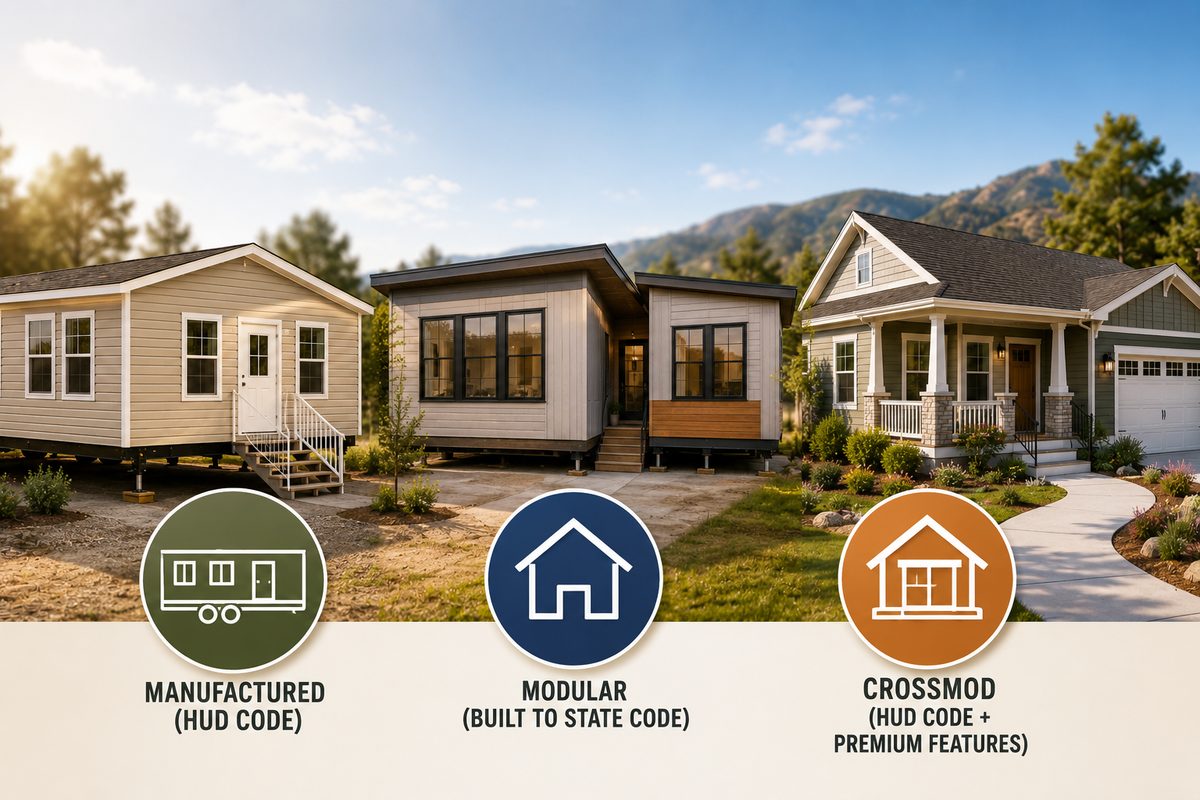
Manufactured homes: one federal code, valid nationwide
A manufactured home is built to the federal Manufactured Home Construction and Safety Standards — the HUD Code — which has governed these homes since June 15, 1976. Because the standard is federal, it preempts local building codes for the structure itself, which is why the same home can be built in one state and shipped to another without being re-engineered for each jurisdiction.
The homes are built on a permanent steel chassis that makes them transportable, and they arrive either as one section (single-section) or as two or more sections joined on site (multi-section). The federal standard covers the home. It does not cover the ground it sits on: the foundation, utilities, setbacks, access, and permits remain the local jurisdiction's business.
One point of vocabulary worth clearing up, because it still causes confusion in listings and conversations: homes built before the HUD Code took effect in 1976 are properly called mobile homes. Anything built to the HUD Code since then is a manufactured home. They are not the same product, and they are not treated the same way by lenders, insurers, or local agencies.
California adds a protection that surprises a lot of buyers. Under Government Code section 65852.3, a city or county shall allow a HUD-certified manufactured home on a lot zoned for single-family residential use, provided the home is installed on a foundation system under Health and Safety Code section 18551. The local agency may apply the same development standards it would apply to a conventional house on that lot — setbacks, yard requirements, parking, minimum floor area — and it may regulate roof overhang, roofing material, and siding material. What it may not do is apply standards that have the effect of precluding manufactured homes as permanent residences.
That is a real protection, but it is not a blanket right. It applies to installation on a foundation system, and the parcel still has to work on its own terms: zoning, access for delivery, utilities, drainage, and any overlay requirements. Confirm the specifics for your parcel with the local planning and building department before you commit.
Modular homes: California's building standards, built indoors
A modular home is also built in a factory in sections, but it is built to the same state and local building standards as a site-built house rather than to the HUD Code. California regulates this category as factory-built housing.
The oversight split is worth understanding, because it is often described incorrectly. The California Department of Housing and Community Development runs the Factory-Built Housing program: HCD approves the design and oversees the manufacturing, and an HCD insignia affixed at the factory certifies that the work met state standards. Your local building department is not re-inspecting the factory work. It handles the permits, the foundation, the site work, and the final inspections once the home is on the ground.
Because the home is built to the same code as conventional construction, a modular home placed on a permanent foundation is generally treated as real property and financed and appraised much like a site-built house. The trade-off is usually cost: a modular home typically carries a higher price per square foot than a comparable HUD-code home.
CrossMod: a manufactured home built to reach conventional financing
CrossMod is the newest of the three and the one buyers have usually heard the least about. It is an industry designation for a HUD-code home built with the features needed to qualify for two specific mortgage programs: Fannie Mae's MH Advantage and Freddie Mac's CHOICEHome. The two agencies have aligned their construction specifications, so a home built to one specification is generally being built to both.
The features are what you would expect from the goal: a permanent foundation, a pitched roof with eaves, a covered porch or a garage or carport, drywall throughout, and energy performance above the baseline HUD requirement for the region. Freddie Mac's CHOICEHome specification, for example, sets minimum insulation values for ceiling, wall, and floor. A label applied at the factory certifies the manufacturing side; the lender is responsible for verifying that the site-related requirements were actually met.
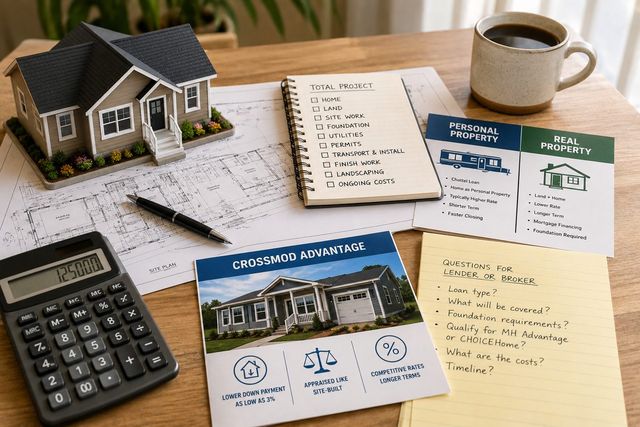
The financing consequence is the whole point of the category. When both the home and the site qualify, these loans are appraised using site-built comparables rather than manufactured-home comparables, the manufactured-home credit fee in price is waived, and down payments as low as 3 percent are possible under certain affordable loan products. Whether any particular home and property qualify is determined case by case by the lender and the appraiser — not by the manufacturer, and not by us.
Side by side
| Manufactured (HUD Code) | Modular / factory-built | CrossMod | |
|---|---|---|---|
| Built to | Federal HUD Code | California building standards | Federal HUD Code plus program specifications |
| Factory work certified by | HUD-approved inspection agencies | California HCD insignia | HUD, plus a factory-applied program label |
| Foundation | Support system or permanent foundation | Permanent foundation | Permanent foundation required |
| Typical titling | Personal property unless converted to real property | Real property | Real property when installed accordingly |
| Financing commonly used | Chattel loan or real-property loan | Conventional mortgage | Conventional, via MH Advantage or CHOICEHome when eligible |
| Appraisal comparables | Manufactured-home comparables | Site-built comparables | Site-built comparables under those programs |
| Typical cost per square foot | Generally the most attainable | Generally the highest of the three | Generally in between |
General patterns only. Titling, financing eligibility, appraisal treatment, and local approval are determined for each specific home and property by the lender, the appraiser, and the local agency.
What this means for buyers
If the home is going on land you own and conventional mortgage treatment matters to you — lower rate, longer term, appraisal against site-built comparables — CrossMod and modular are the two categories worth examining closely. Which of the two makes sense usually comes down to budget and to what the local jurisdiction expects.
If the home is going into a community or onto leased land, a HUD-code manufactured home is normally the practical answer, and the financing conversation will usually start with a personal-property loan. CrossMod's advantages are tied to a permanent foundation and land ownership, so they generally do not travel to a leased space.
And if value per square foot is the priority and the site permits it, a standard HUD-code manufactured home delivers the most house for the money of the three.
None of these categories is universally better than the others. The right answer depends on the parcel, the local jurisdiction, the financing path, and how long you plan to stay. That is why we ask about the land before we ask which floor plan you like — the land usually narrows the field before the floor plan does.